Basic Life and Family Roots
Irene Marie Bloecker entered the world on April 1, 1901. Her life began in a period when women’s private histories were often sparsely recorded. She was born to Charles Bloecker and Laura Lautenschlager, names that anchor her in a distinctly Midwestern domestic world. Those family ties suggest a plain foundation before fame altered her public identity.
Her surname changed across successive phases of life. She was first Bloecker, then Pineau through marriage, and later Johnson. Each name marked a legal and personal transition. Together, they form a biography shaped by kinship, marriage, and endurance.
Irene’s early years likely unfolded far from national attention. The record preserves her later associations more clearly than her childhood circumstances. That imbalance is common in historical memory. Private lives are often reconstructed only after public events cast a long shadow backward.
Crossing Paths With Jack Johnson
In 1924, Irene met Jack Johnson at a racetrack in Aurora, Illinois. The setting matters because it reflects motion, spectacle, and social energy. Racetracks were lively public spaces, filled with wagers and restless anticipation. Their meeting occurred in a setting already charged with chance.
At that moment, Jack Johnson remained a formidable public figure. His fame had been forged through boxing, travel, and controversy. Irene encountered him not in a quiet parlour, but within a kinetic environment. That detail gives the meeting a vivid and almost cinematic quality.
Their relationship continued after Irene’s prior marriage ended in early 1925. The timeline shows a swift progression from meeting to marriage. It also suggests that her personal life was already in transition when she crossed paths with Johnson. The speed of those events gives the story a brisk, decisive rhythm.
Marriage in Waukegan
Irene married Jack Johnson in August 1925 in Waukegan, Illinois. The ceremony was civil and conducted by a justice of the peace. It was modest, direct, and unsentimental. Such a ceremony suits a relationship that would be tested by public scrutiny and movement.
The wedding did not announce itself through grandeur. There was no elaborate public pageant attached to the union. That restraint is revealing. It suggests a practical partnership grounded in commitment rather than display.
From that date forward, Irene became more visible in photographs and public references. Her role was not ornamental in the shallow sense. She stood beside a man whose life demanded a steady companion. The marriage placed her inside a larger narrative, one defined by travel, visibility, and resilience.
Public Life and Travel
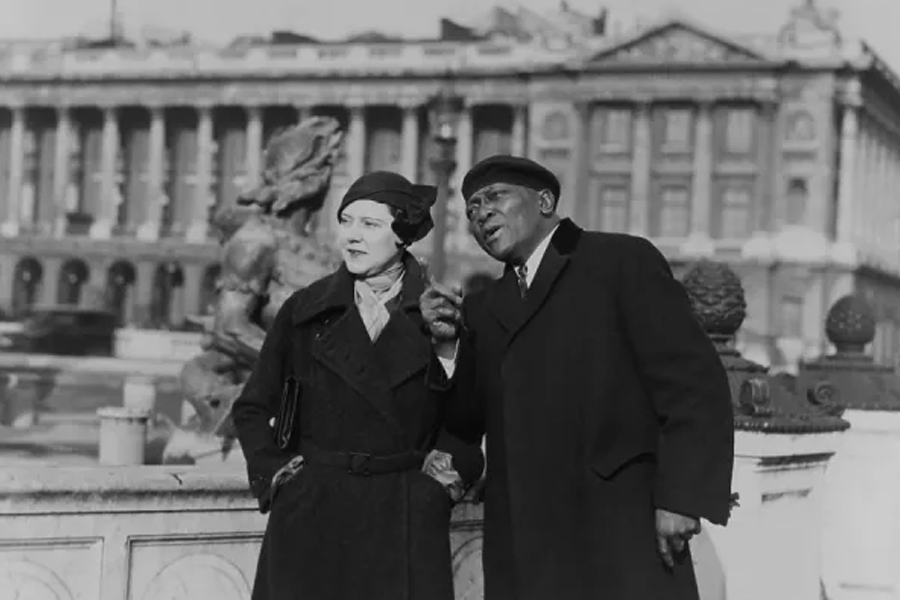
The 1930s carried Irene into public spaces in Europe and the United States. She was photographed in Paris during that decade. She also appeared at the Los Angeles nightclub opening of The Showboat on October 7, 1931. These moments map a life adjacent to performance and celebrity.
Her public presence was often relational rather than self-authored. She was seen with Johnson at events, on walks, and in social settings. That does not diminish her significance. It clarifies the nature of her role, which was companionship sustained under pressure.
The image of Irene in Paris hints at cosmopolitan movement. The Los Angeles appearance places her in the orbit of nightlife and entertainment. Together, those scenes reveal breadth. She moved through spaces that linked sport, leisure, and transatlantic modernity.
| Date | Event |
|---|---|
| April 1, 1901 | Birth of Irene Marie Bloecker |
| 1924 | Meets Jack Johnson in Aurora, Illinois |
| Early 1925 | Divorce from Harry Pineau |
| August 1925 | Marries Jack Johnson in Waukegan, Illinois |
| October 7, 1931 | Appears at The Showboat opening in Los Angeles |
| 1930s | Public appearances in Paris and elsewhere |
| June 10, 1946 | Jack Johnson dies |
| January 13, 1992 | Irene dies |
Family Names and Personal Continuity
Irene’s family story remains legible through a compact set of names. Charles Bloecker and Laura Lautenschlager appear as her parents. Harry Pineau appears as a prior husband. Jack Johnson appears as her later husband and enduring public association. These names constitute a skeletal genealogy.
The prior marriage to Harry Pineau ended in early 1925. That detail matters because it situates Irene as a woman with an already complex adult life before the Johnson marriage began. Her biography is not reducible to a single union. It includes previous commitments and subsequent reinvention.
Family names preserve continuity amid change. They also show how women’s identities were often recorded through marital transitions. Irene’s life illustrates that pattern precisely. Her personal history survives in fragments, but the fragments remain coherent.
Loss and Widowhood
Jack Johnson died on June 10, 1946, in an automobile accident. That date marked a major rupture in Irene’s life. She became a widow after two decades of marriage. The event ended a long shared chapter and reopened her life to solitude.
Her response to his death reveals emotional economy and composure. She said, “I loved him because of his courage…” The phrasing is concise and potent. It honors a quality that defined Johnson in public life and likely in private as well.
Widowhood transformed Irene’s position in the historical record. She no longer appeared merely as a companion at events. She became the surviving witness to a famous life. Her memory of Johnson carried both intimacy and authority.
Later Years and Long Memory
Irene lived until January 13, 1992. Her lifespan stretched across 91 years. That span covered dramatic social changes, including two world wars, shifting gender roles, and the rise of modern mass media. Her life thus traversed a remarkably broad historical arc.
The later decades of her life were quieter than her public years. There is no widely documented independent career attached to her name. Instead, she remained known for her association with Jack Johnson and for the dignified persistence of her presence. Silence in the record should not be mistaken for insignificance.
Her life demonstrates how certain biographies endure through relational memory. She was remembered because she stood near a towering athlete. Yet the historical interest in her also stems from steadiness. She embodied continuity across change, and that quality gave her life narrative weight.
Timeline of Key Events
| Year | Event | Place |
|---|---|---|
| 1901 | Birth | Illinois |
| 1924 | Meets Jack Johnson | Aurora, Illinois |
| 1925 | Divorce and remarriage | Illinois |
| 1931 | Public nightclub appearance | Los Angeles |
| 1930s | Travel and appearances | Paris and other cities |
| 1946 | Widowhood after Johnson’s death | United States |
| 1992 | Death | United States |
This sequence shows a life structured by dates that remain unusually precise. The record is strongest when tied to public moments. Even so, the intervals between those moments matter. They suggest years of ordinary continuity, domestic labor, and lived companionship.
Key Takeaways
Irene Pineau Johnson was born Irene Marie Bloecker on April 1, 1901. She married Jack Johnson in August 1925 after meeting him in 1924 at a racetrack in Aurora, Illinois. Her earlier marriage to Harry Pineau ended in early 1925. She appeared with Johnson in public settings during the 1930s, including Paris and Los Angeles. Johnson died on June 10, 1946, and Irene lived until January 13, 1992. Her life is remembered for companionship, steadiness, and a restrained presence beside a celebrated champion.